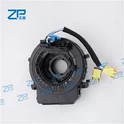
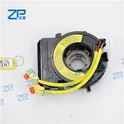
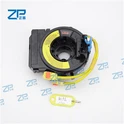
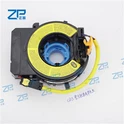
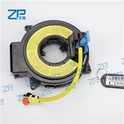
The car clock spring (Clock Spring), also known as a spiral cable or hairspring, is a key component of the airbag system. Its core function is to maintain continuous circuit connectivity as the steering wheel turns, ensuring the normal operation of the airbag, horn, and other functions. Below is a detailed analysis of its working principle:
1. Structural Features
Spiral Cable Design
The clock spring consists of a flat spiral cable (copper wiring) and a plastic housing. The cable is tightly wound around a reel, similar to a clock's mainspring (hence the name "clock spring").
The outer housing is fixed to the steering column, while the inner reel connects to the steering wheel, allowing it to rotate left or right (typically up to 2.5 turns).
The cable's two ends connect steering wheel electrical components (e.g., airbags, horn switches) to the vehicle's main circuit.
Electrical Connection Points
One end connects to the steering wheel's airbag module, horn contacts, etc., via a plug.
The other end links to the vehicle's wiring harness, integrating with the overall circuit system.
2. Working Principle
1. Circuit Continuity During Steering Wheel Rotation
When the steering wheel turns, the clock spring's inner reel rotates with it, while the outer housing remains fixed. The spiral cable flexes and rotates elastically to accommodate the steering angle.
This design allows the cable to wind or unwind within a range (typically ±360° to ±540°), preventing wire breakage from over-stretching and ensuring continuous transmission of airbag trigger signals, horn controls, etc.
2. Role in the Airbag Triggering Mechanism
During a collision, the airbag control module (SRS ECU) sends an electrical signal through the clock spring's cable to the steering wheel's airbag igniter when impact force exceeds a threshold.
The current ignites explosives in the igniter, triggering the gas generator to inflate the airbag rapidly.
Critical Point: A damaged clock spring (e.g., broken cable or poor contact) disrupts signal transmission, rendering the airbag inoperable and increasing accident risks.
3. Transmission of Other Functions
Horn Control: When the horn button is pressed, signals travel through the clock spring to the vehicle's circuit, activating the horn.
Multi-Function Buttons: In some models, the clock spring also connects to steering wheel buttons (e.g., cruise control, volume adjustment).
3. Common Faults and Impacts
Fault Symptoms
Airbag Warning Light On: Indicates internal cable damage or disconnection detected by the system.
Inoperative Horn: Failure to transmit horn control signals through the clock spring.
Malfunctioning Buttons: Unresponsive steering wheel controls if their circuits are linked to the clock spring.
Causes
Wear and Tear: Aging or fraying of the cable from prolonged use.
Improper Installation: Misalignment during steering wheel repair, causing excessive cable twisting.
External Damage: Collisions or incorrect maintenance procedures.
Risks
Airbag Failure: Inability to deploy during a crash, compromising occupant safety.
Horn Dysfunction: Reduced ability to signal other drivers, increasing collision risks.
4. Maintenance and Replacement Precautions
Installation Alignment
Replacements require positioning the clock spring at its neutral ("zero") position to ensure symmetrical steering wheel rotation and prevent cable over-winding.
Many models feature alignment marks or pins that must be precisely matched during installation.