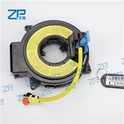
In the automobile airbag system, the clock spring (also known as the spiral cable) serves as the core component for achieving synchronous rotation transmission of signals and gas pipelines. Its working principle and specific implementation mechanisms are as follows:
Structural Design
The clock spring features a spiral - coiled structure, resembling a tape measure, and is mounted in a fixed position between the underside of the steering wheel and the steering column. Internally, it comprises multiple layers of flat conductive metal strips (used for signal transmission) and specialized gas pipeline channels (available in certain vehicle models). As the spring coils, these metal strips and pipeline channels are densely arranged. One end of the spring is rigidly attached to the steering column, remaining stationary, while the other end connects to the steering wheel, rotating in tandem with its movements.
Signal Transmission
Electrical signals from components such as the automobile airbag system and horn must be relayed to the vehicle's Electronic Control Unit (ECU) via the steering wheel. The conductive metal strips within the clock spring play a pivotal role in this process. When the steering wheel rotates, the unique spiral design of the clock spring enables the metal strips to wind and unwind within a confined space while maintaining continuous electrical connectivity at both ends. These metal strips interface with the control switches, sensors, and the vehicle's circuitry on the steering wheel through dedicated connectors, ensuring stable and uninterrupted transmission of various electrical signals, including airbag deployment triggers and horn activation commands.
Gas Pipeline Transmission
In some airbag systems where the gas generator is integrated into the steering wheel, it is essential to convey the gas produced by the generator to the airbag. The clock spring incorporates a specially designed gas pipeline channel, constructed from flexible materials that offer excellent bendability. As the steering wheel turns, the gas pipeline deforms flexibly with the expansion and contraction of the clock spring, guaranteeing unobstructed gas flow from the generator to the airbag. This design prevents issues such as pipeline kinking, blockage, or breakage caused by steering wheel rotation, thereby ensuring the airbag deploys promptly and effectively upon impact.
Synchronous Coordination Mechanism
To ensure seamless synchronous transmission of signals and gas, stringent requirements govern the clock spring's material properties, structural dimensions, and installation during the design and manufacturing phases. For instance, the conductive metal strips must exhibit high flexibility, conductivity, and fatigue resistance to withstand repeated telescopic motions. The gas pipelines require appropriate flexibility and airtightness. Moreover, the clock spring's rotation angle range is meticulously calculated and rigorously tested to ensure that signal transmission and gas delivery remain unaffected within the steering wheel's normal rotation range (typically around 2.5 turns in either direction). Additionally, during vehicle assembly, the clock spring undergoes thorough calibration and testing to guarantee its operational reliability and stability.