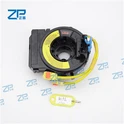
Clock Springs for Different Vehicle Models: Non-Universality and Key Purchase Parameters
Clock springs are not universally compatible across vehicle models. Their design must strictly align with the steering system, wiring harness interfaces, and safety functions of specific vehicles. When purchasing, focus on the following parameters to ensure compatibility:
1. Core Reasons for Non-Universality
A. Structural Matching Differences
Clock springs require precise integration with components like the steering wheel, steering column, and combination switch. Examples include:
Drive Column and Steering Wheel Hole Compatibility:
Some models use a single drive column paired with an oblong steering wheel hole.
Others rely on spline protrusions and grooves for alignment.
Neutral Position Marking:
Neutral positions are identified differently (e.g., orange balls, logo alignment, or visible flat cables).
Misinstallation can cause functional failures or safety hazards.
Case Study:
BYD vehicles require the clock spring rotor connector to align at 6 or 12 o'clock, with the neutral bolt locked.
Mitsubishi models may confirm neutral position via an orange ball visible through a transparent window.
B. Wiring Harness Interface and Functional Compatibility
Clock springs connect to steering wheel buttons, airbags, turn signals, etc. Pin counts, definitions, and protocols vary by model.
Case Study:
Upgrading a 6th-generation Camry's steering wheel to a high-end version requires replacing the clock spring if the original system lacks multi-function button support.
C. Safety and Regulatory Requirements
As critical safety components, clock springs must pass collision tests and electromagnetic compatibility (EMC) certifications, which differ across models.

2. Key Purchase Parameters
A. Vehicle Adaptability
Original Part Number: Match the vehicle's VIN code or the number on the original clock spring (e.g., Hualing Heavy Truck's 37AA-74025).
Brand/Model Compatibility: Prioritize OEM or certified aftermarket parts (e.g., Mitsubishi ASX-specific clock springs) to avoid functional limitations.
B. Physical Parameters
Outer Diameter and Thickness: Ensure compatibility with the steering column bracket and combination switch to prevent interference or loosening.
Rotatable Turns: Typically, reserve 0.5 turns; excess turns may increase failure rates.
Neutral Position Marking: Verify alignment with vehicle requirements (e.g., ball, logo, or flat cable indicators).
C. Electrical Parameters
Pin Count: Common configurations include 12-pin or 16-pin interfaces, which must match the original harness plug.
Resistance and Current Capacity: Ensure compatibility with steering wheel buttons and airbags to avoid signal interference or component damage.
D. Environmental Adaptability
Operating Temperature Range: Must cover vehicle usage conditions (e.g., -40°C to 85°C).
Durability Testing: Look for certifications like 10 million rotation cycles, high-temperature/humidity resistance (e.g., 120°C at 90% RH).

3. Installation and Debugging Precautions
A. Neutral Position Alignment
Straighten the steering wheel and ensure the vehicle's wheels are aligned.
Rotate the steering wheel clockwise to the limit, then counterclockwise 2.2–2.5 turns to reach neutral (refer to the vehicle manual for exact specifications).
Risk: Improper alignment may fracture internal cables, leading to airbag or turn signal failures.
B. Secure Fixing
Use clips or screws to align the clock spring with installation holes on the steering column and combination switch, preventing looseness or noise.
C. Functional Testing
After installation, verify:
Steering wheel return-to-center functionality.
Proper operation of buttons and turn signals.
Airbag warning light status (no fault codes should be present).
Contact Us
+86-0577-66000879
HUANGJINBU TOWN,SHANGRAO CITY,JIANGXI PROVINCE,CHINA