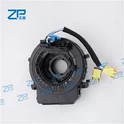
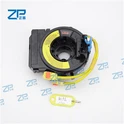
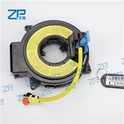
The clock spring, also known as a rotary connector and airbag hairspring, is used to transmit the electrical signal of the airbag. It is connected to the gas trigger and impact sensor through its unique structure, and at the same time ensures the smooth rotation of the steering wheel.
The essential structure of the clock spring is a section of wiring harness connecting the ECU and the steering wheel airbag. Because the main airbag rotates with the steering wheel, the connection harness must have a margin to ensure that the steering wheel can be turned to the extreme position to one side without being pulled off. There are two common installation methods: one is to fix it on the steering wheel, and the other is to fix it on the combination switch.
1. The structure and working principle of the clock spring
The clock spring is mainly composed of a flexible flat cable (FFC), a shell and a wire core. Its working principle is to connect it to the gas trigger and impact sensor through a unique structure. When the steering wheel rotates, the clock spring can maintain electrical connection to ensure the normal operation of safety devices such as airbags.

2. Lubrication requirements for clock springs
Reduce wear: In normal operation, grease is required between the upper and lower shells of the clock spring and when the FFC itself moves in relative tension to reduce premature wear of rubber parts and wiring harnesses.
Improve flexibility: The application of grease can also ensure that the clock spring rotates more flexibly and reduce resistance during rotation.
Reduce noise: Proper lubrication can reduce the noise generated by the clock spring when rotating and improve the driving experience.
3. Selection and application of grease
Grease type: Since the components in the clock spring are mainly plastic parts (POM, PA, PP, etc.), lubricants with good plastic compatibility such as PAO grease or silicone grease are considered the first choice. These lubricants have excellent plastic compatibility and can ensure compatibility with clock spring materials.
Working temperature: The working temperature range of clock springs is usually between -40°C and 80°C, and special cases require -50°C to 120°C. Therefore, the selected grease should be able to maintain good lubrication performance within this temperature range.
Long life and maintenance-free: As a precision electronic component of automobiles, clock springs require grease to be long-lasting and maintenance-free, ensuring a service life of about 100,000 times.
Low diffusion and environmental protection: As an automotive interior component, the grease of clock springs should have good low diffusion, while meeting environmental protection requirements such as low volatility and low odor (VOC).
Construction performance: Since the amount of grease used on each clock spring is small (0.5~1 gram on the housing, about 1 gram on the wiring harness), the grease is required to have good pumping performance and avoid oil separation to meet the needs of automated construction.
In actual applications, the grease commonly used in the industry is mainly plastic/plastic grease suitable for low speed and light load, such as Molykote EM-50L, EM-60L, etc. With the increase in diversified customer needs, more options such as Molykote T-Grease series products (G-1079) and silicone-based products (PG-21) have also emerged to meet the lubrication needs under different working conditions.
4. Lubrication construction and maintenance
Before applying grease, the surface of the clock spring needs to be cleaned to ensure that the grease can adhere firmly to the surface and play an effective lubricating role. During use, the lubrication of the clock spring should also be checked regularly to replenish or replace the grease in time.