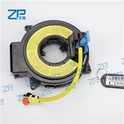
I. Core Conclusion: Clock springs are not versatile and can only be used across models under certain conditions.
There is no absolute answer to the interoperability of clock springs. The key is the ``platform commonality"and ``function configuration consistency" of the whole car. The general principle is that interoperability between models of different brands is generally not possible. Models from the same brand, platform and configuration may be compatible, but key parameters must be rigorously verified. Blind mixing can easily lead to risks such as airbag failure and short circuits.
ii. Interoperability Analysis
1.Interoperability between models of different brands: Interoperability is almost impossible, and there are multiple barriers to adaptation.
Even among models of the same price and class (like the Volkswagen Lavida and Toyota Corolla), clock springs rarely interact. The core reasons for this are:
Different design standards: Different brands have different steering system architecture (steering column diameter, steering wheel rotations) and airbag activation protocols. For example, the clock springs in BMW models must be compatible with its "iDrive system key circuit, while the clock springs in Toyota models must be compatible the"TSS Intelligent Driving Safety System. Circuit interfaces and signal transmission logic are completely different.
Physical structure conflicts: Some brands implement "interface anti-matching designs" to prevent mismatches. For example, airbag connectors have different the keyway shapes (e.g., Volkswagen's square keyway and Honda's round keyway). Forcing connectors into place can damage connectors and physically prevent interoperability.
Case study: While both the Rolls-Royce Wraith and BMW 6 Series are part of the BMW Group and share a platform, the direct installation of BMW clock springs still requires replacement of adapter rods, making interoperability less practical. This type of "cross-brand compatibility" exists only in extreme cases within the same group, where platforms are deeply shared and not universally applicable.
2. Different models of the same brand: There are two types of interoperable: "interoperable" and "non-interoperable."
Interoperability between models of the same brand depends on their "platform affiliation" and "configuration differences."
Interoperability scenarios: Models with the same platform and configuration may be interoperable. Volkswagen Group MQB platform models (Golf, Lavida and Sagittarius), for example, have identical clock spring OE codes (e.g. 1K0959653) and can be directly interchangeable if they don't come with add-ons such as fixed cruise control and heated steering wheels. Models from Volkswagen brands Audi, Skoda, Skoda and others on the same platform often share clock springs with the same OE code.
Interoperability not possible:
Different platforms: The steering column structure of the BMW 3 Series (CLAR platform) and BMW 1 Series (UKL front-wheel drive platform), for example, is very different, leading to completely different holes and methods of installing clock springs.
Configuration differences: High-end and low-end versions of the same model may differ. High-end models with cruise control and steering wheel controls require one or two additional clock spring circuit connectors, while lower-end models with only horn and airbag support require fewer connectors (usually four pins or four pins). 6-pin). Mixed components (such as needles) can lead to loss of function or circuit redundancy.
Production year iteration: Even for the same model, the internal spring material and clock spring's anti-jamming design are upgraded in tandem with a modified steering system (such as switching from mechanical to electronic power steering), making the old and new models incompatible.
III. Five Key Compatibility Parameters for Determining Interoperability of Clock Springs
Whichever model is used, the following parameters must be met simultaneously to confirm compatibility:
1. OE Code (The Most Important Parameter)
The OE code is the only identifier that the manufacturer assigns to each component. Identical codes usually indicates compatibility. For example, Volkswagen's 1K0959653 code covers multiple models, including the Audi A3, Seat Leon and Skoda Octavia. You can check the target model's the OE code at a 4S dealership or an aftermarket platform and compare it to the parts to be replaced. Note: Some manufacturers may adjust the code suffix (e.g. 1K0959653A or (1K095965B). If core prefix prefix is the same and the attachment provider confirms compatibility, they can still be used interchangeably.
2. Circuit Interface and password counting
Interfaces must meet Physical Compatibility + Feature Matching:
Physical compatibility: Plug shape and keyway position must be the same to avoid insertion problems or poor contact.
Pin count: Basic models (speakers and airbags only) typically have 4 pins, while models with cruise control and buttons have 6 to8 pins. The count of pins must match perfectly-models with more pins are compatible with models with fewer pins (extra pins not used), but models with fewer pins arenot compatible with models with more pins (due to lack of functionality).
3. Installation Dimensions and Fixing Methods
External Dimensions: external dimensions and height must match the original component, otherwise the steering column shield cannot be installed.
Mounting Hole Positioning: The number and spacing of fixed bolts must match (e.g., 3 M6 bolts, spaced 50mm). Incorrect hole positioning can lead to improper or loose mounting.
Steering Column Compatibility: The diameter of the inner hole must match the maximum diameter of the steering column (e.g., 18mm vs. 20mm). Too loose can cause loosening and too tight can cause steering column to seize stuck.
4. Clockwork Turnss
The wind-up rotation must match the maximum rotation of the steering wheel rotation (which is usually allowed to exceed the the steering wheel's maximum rotation by 0.5 laps). For example, if the steering wheel of an average family car rotates 1.5 laps to the left and right (a total of 3 laps), the clock spring must support 3.5 laps. If you install a clock spring on this model that only supports 2.5 laps, the wind-up will snap when the steering wheel turns completely. Different models have different steering ratios (sports cars, for example, have smaller steering ratios and fewer turns), so the number of turns is bound to vary.

V. Functional Compatibility
the vehicle's additional function requirements must be met:
Basic Functions: All clock springs support speakers and airbags, but the airbag trigger resistance must be compatible (Toyota requires omega 2, Honda requires omega 3). Incompatible resistances will cause airbag warning light to permanently glow.
Bonus: For models with heated steering wheels, clock springs must have high temperature (temperature resistance ≥ 120°C). Models with Head-Up Displays (HUDs) require additional signal transmission lines; standard models are not compatible.
IV. INTRODUCTION Practical tips: 3 key points to avoid Commonality Risks
Prioritize OE Code Verification: Before you buy, use the "VIN Number Lookup" method (you can enter a VIN code on the attachment platform) to ensure that the code for the new part matches the original part. This is the most time-efficient and accurate method.
Avoid "empiricism": Even if they look similar, don't simply assume that they are based on outward commonalities. Some components have different internal hairspring materials and circuit layouts (for example, plain windings and an anti-interference silver-plated hairspring). While they may work for a short period after installation, they may experience intermittent outages in the long run.
Professional channel verification: If you require cross-model compatibility (for example, different configurations for the same brand), be sure to consult the parts department of a a 4S dealership or professional repair shop for model year and configuration information for both vehicles. Specification of professional verification to avoid miscalculation of safety hazards.